Tag: cafe menu ideas
Mango Lassi for Cafes Looking Beyond the Summer Smoothie
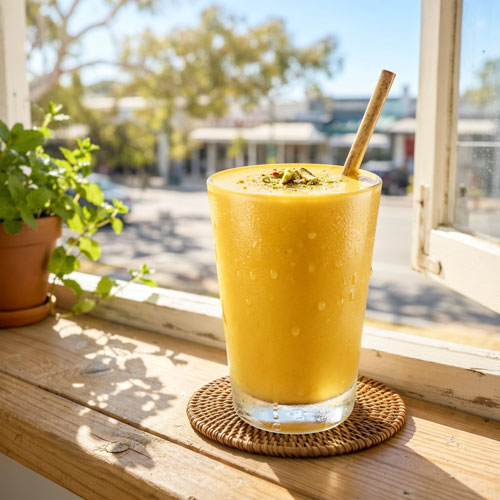
Most cafe summer drinks menus follow the same format. Smoothie variations, differentiated by which fruit goes in and which booster goes with it. It sells, but it limits the range. Every option on the board is the same drink in a different flavour. A mango lassi is something else. A cold drink with its own identity, one that many customers already recognise and don’t need explained. It’s a hot-weather drink across South Asia and beyond, largely because of what the yoghurt does.
If you’re rethinking your summer menu, a mango lassi adds a cold drink unlike anything else you serve. This isn’t a smoothie with yoghurt added. It’s a yoghurt drink with mango, and the difference is structural.
In this article you will learn what sets a mango lassi apart from a smoothie, how to serve and price it on your summer cafe menu, and whether fruit powder is a practical ingredient for making it.
What makes a mango lassi different from a smoothie?
A mango lassi balances mango sweetness, yoghurt tang, and a texture that pours. The yoghurt is the base of the drink. It provides body, acidity, and a slight savoury edge that keeps the drink from tasting like another sweet cold option. The mango brings aroma and sweetness, but the yoghurt is doing equal work.
That acidity is also what makes a lassi a summer drink. Sweetness on its own turns cloying in the heat. Acidity cuts through it, so the drink refreshes rather than simply cooling.
The texture is the other defining feature. A mango lassi should move when you tip the glass. Rich enough to feel substantial, thin enough to drink freely through a wide straw. If it holds its shape like a smoothie, you’ve made a smoothie. The line between the two is consistency. A lassi pours freely; a smoothie has to be coaxed.
Yoghurt choice shapes the result. Natural yoghurt gives a lighter body and sharper acidity. Greek yoghurt adds richness and a thicker mouthfeel, which may need thinning with milk or water. The right choice depends on the balance you want.
A lassi usually needs some added sugar, even with ripe mango. The yoghurt’s acidity needs balancing. How much depends on the mango’s sweetness and the yoghurt’s tang, but it’s a variable to calibrate rather than skip. Cardamom is traditional in many versions. A small amount adds warmth without competing with the mango. It’s a worthwhile option to test but not essential, and some customers will find it unexpected.
How should a cafe serve and price a mango lassi?
Traditional mango lassi servings tend to be smaller than the standard Australian cafe smoothie, often closer to 300–350 ml, where a smoothie commonly runs 450–600 ml. Somewhere around 350–400 ml makes sense for most menus. It’s a drink, not a meal, and the smaller serve works commercially. Ingredient cost is modest, and the perceived value sits above a juice and close to a smoothie. The margin on a well-made lassi in a smaller glass is solid.
Where it sits on the menu affects how customers see it. List it under smoothies and it becomes a smoothie variant. Given its own place, under cold drinks or as a standalone item, it reads as something distinct, which is the point.
The description should be short. “Mango Lassi” is self-explanatory for most customers. If a one-line descriptor helps, try Indian-style mango and yoghurt drink, served cold. Don’t weight it with health language. Adding “probiotic” or “rich in vitamins” to the menu board turns a drink people order because it tastes good into a drink people order because they think they should. Taste is what usually brings customers back for a second order.
Does mango powder work in a mango lassi?
Boost Nutrients’ Australian mango fruit powder is made from 100% Kensington Pride mango puree, with no fillers. If you’re serving mango lassi through a busy summer, the operational case for a powder is straightforward. There’s no ripeness variation to manage, no portioning judgment, and almost no prep waste. It also keeps the sugar balance steady. Fresh mango sweetness changes from tray to tray, so a recipe balanced on Monday can taste sharp by Thursday. With powder, the balance is set once in the recipe and holds, at a cost per serve that doesn’t move with the fresh mango price.
For best results, reconstitute the powder before it goes into the lassi rather than adding it straight to the blender. The rehydration ratio is 100 g of powder to 650 ml of water, yielding 750 g of mango puree. From there, the recipe is yours to develop. Work out how much puree suits your yoghurt, how much sugar it needs and how thin you want it to pour.
Once the recipe is set, the powder gives you the same mango lassi on the first hot day of summer and the last, faster to make and at a fixed cost per serve.
Mango is one of several Australian-made fruit powders from Opera Foods. Browse our Boost Nutrients fruit powder range to find the right fit for your kitchen.
This article was reproduced on this site with permission from operafoods.com.au the “Wholesale Fruit Powder Supplier”.
See original article:- Mango Lassi for Cafes Looking Beyond the Summer Smoothie