Category: Smoothie Recipes
Bee Pollen Smoothies: Elevate Your Cafe Menu with Nature’s Golden Superfood
Read time: 7 minutes
Looking at those golden granules topping smoothie bowls across Australian cafes? That’s bee pollen, and if you’re not yet offering it to your health-conscious customers, you’re missing an opportunity to differentiate your menu with minimal effort.
For cafe owners and dessert bar operators, bee pollen delivers exactly what modern customers want: visual appeal, genuine nutritional benefits, and an ingredient story worth sharing. It’s the sort of addition that transforms a standard smoothie into something memorable without disrupting your workflow or requiring specialist training.
The superfood category continues growing in Australian hospitality, and bee pollen sits perfectly within this trend—easy to source, simple to use, and genuinely beneficial. Let’s explore how to incorporate it into your offerings with three distinctive smoothie recipes designed for commercial success.
Understanding Bee Pollen: What Makes It Special?
Bee pollen consists of tiny granules collected by honeybees as they visit flowers, mixed with nectar and enzymes to create a nutrient-dense food source. Beekeepers harvest small amounts from hives without disrupting bee colonies, which makes it a sustainable ingredient choice for cafes committed to ethical sourcing.
The nutritional profile explains its growing popularity. Bee pollen contains over 250 bioactive compounds, including all essential amino acids—making it a complete protein—along with B vitamins, vitamins C and E, minerals like iron and zinc, plus antioxidants such as flavonoids and phenolic acids. Research published in peer-reviewed journals confirms its anti-inflammatory properties, immune-supporting compounds, and potential benefits for energy metabolism.
The flavour profile is distinctive without being overpowering: mildly sweet with floral notes and a subtle honey-like quality. The texture adds a pleasant, delicate crunch that works beautifully as both a blended ingredient and a visual garnish.
Most importantly for cafes, it’s remarkably versatile. Bee pollen enhances tropical smoothies, complements green blends, and works equally well with dairy, plant-based milks, or yoghurt bases. The golden colour photographs beautifully for social media, which matters significantly in today’s visually-driven cafe culture.
Three Commercial Smoothie Recipes Using Bee Pollen
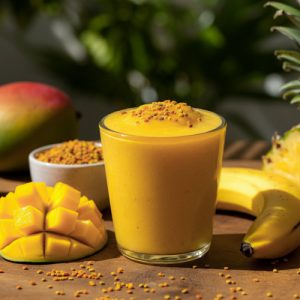
1. Tropical Sunrise Smoothie
This vibrant blend capitalises on Australia’s enduring love for tropical flavours whilst showcasing bee pollen’s golden hue. It’s particularly suited to warmer months and appeals to customers seeking refreshing, energising options.
Ingredients (yields one 450ml serve):
- 150g frozen mango chunks
- 80g frozen pineapple chunks
- ½ medium banana (approximately 60g)
- 120ml coconut water (substitute regular filtered water if preferred)
- 2 tablespoons Greek yoghurt (or coconut yoghurt for vegan menus)
- 1 teaspoon bee pollen (for blending)
- Additional bee pollen for garnish
Method:
- Combine frozen fruit, banana, coconut water, and yoghurt in your commercial blender
- Add a teaspoon of bee pollen to the blend
- Process on high speed until completely smooth, adjusting liquid if needed for consistency
- Pour into a serving glass
- Garnish generously with bee pollen granules on the surface
Service notes: The yellow-on-yellow colour contrast creates a striking visual appeal. This smoothie works well with both clear and opaque serving cups, though for cafes with Instagram-focused customers, consider serving in a glass cup to showcase the colour gradient.
2. Green Energy Smoothie
Green smoothies remain consistently popular in Australian cafes, particularly with fitness-conscious customers and lunch crowds. This recipe balances earthy greens with natural sweetness whilst maintaining a velvety texture that keeps customers coming back.
Ingredients (yields one 450ml serve):
- 40g fresh baby spinach (approximately 2 large handfuls)
- ½ ripe avocado (approximately 60-70g)
- 1 Granny Smith apple, cored and roughly chopped
- 60g cucumber, chopped
- 250ml unsweetened almond milk (or filtered water for lighter texture)
- Juice of ½ lime (approximately 1 tablespoon)
- 1 teaspoon bee pollen (for blending)
- Additional bee pollen for garnish
- Optional: fresh mint leaves for additional garnish
Method:
- Place all ingredients except garnishes into a commercial blender
- Add a teaspoon of bee pollen
- Blend on high until completely smooth—the avocado creates a luxuriously creamy texture
- Pour into a glass or smoothie bowl
- Top with bee pollen granules, and mint if using
Service notes: The golden bee pollen creates a beautiful contrast against the vibrant green base. For bowl service, consider adding additional toppings like granola, coconut flakes, or sliced kiwi to create an “Instagrammable” presentation that encourages social sharing.
3. Berry Açai Protein Blend
This recipe taps into the ongoing açai bowl trend whilst adding protein for post-workout customers and afternoon energy seekers. The berry-bee pollen combination is both flavourful and photogenic, making it an excellent addition to your breakfast or recovery menu.
Ingredients (yields one 450ml serve):
- 100g frozen mixed berries (strawberries, blueberries, raspberries)
- 1 packet açai puree (typically 100g, frozen)
- ½ medium banana
- 150ml coconut milk (or oat milk for a creamier result)
- 1 tablespoon almond butter (or protein powder alternative)
- 1 teaspoon bee pollen (for blending)
- Additional bee pollen for garnish
Method:
- Combine frozen berries, açai puree, banana, milk, and almond butter in a blender
- Add a teaspoon of bee pollen
- Blend until thick and smooth—açai should create a soft-serve consistency
- Pour into the serving vessel
- Garnish with bee pollen and optional fresh berries
Service notes: This works particularly well as a thick smoothie bowl. The deep purple base makes the golden bee pollen pop visually, creating an eye-catching contrast that photographs beautifully. Consider offering as part of your breakfast or post-workout menu to capture health-conscious morning and afternoon crowds.
Sourcing and Storage Considerations
Getting your bee pollen supply right makes all the difference to both quality and profitability.
Quality sourcing: Source your bee pollen from reputable Australian suppliers. Consider the appeal of local Australian bee pollen to customers interested in supporting regional producers. The local angle often resonates strongly with cafe customers who value transparency and community connection.
Here at Opera Foods, our own brand Boost Nutrients Australian Bee Pollen is sourced from producers that keep their honey “wild and raw” by keeping their bee hives in the bush and more than 6 kilometres from any crops grown with pesticides.
Storage: Store bee pollen in airtight containers in a cool, dark location. Refrigeration extends shelf life to approximately 12 months whilst maintaining quality. Avoid moisture exposure, which can cause clumping and degradation. For busy service periods, keep a small amount in an easy-access container at your prep station whilst storing the bulk supply properly.
Portion control: One teaspoon per serve provides sufficient nutritional benefit and flavour whilst helping control costs. Bee pollen typically ranges from $40-80 per kilogram, depending on quality and supplier, so consistent portioning protects your margins.
Allergen considerations: Bee pollen may trigger reactions in customers with pollen allergies or bee sting sensitivities. Train staff to ask about allergies when customers order bee pollen items, and clearly mark it on menus with standard allergen warnings to meet duty of care requirements.
Don’t forget that, just like honey, bee pollen is not suitable for vegans.
Marketing Your Bee Pollen Smoothies
Having great recipes is only half the battle—you need to communicate their value effectively.
Menu Descriptions That Sell
Generic descriptions don’t capture attention or justify premium pricing. Instead of “Mango Smoothie,” create compelling names with benefit-focused descriptions like this:
“Tropical Sunrise Bowl – Energising mango, pineapple and coconut water blend supercharged with nutrient-rich bee pollen. Naturally rich in complete protein, B vitamins and antioxidants.”
Notice the structure: evocative name, key ingredients, followed by specific benefits. This format works across menu formats and helps staff communicate value to customers who ask, “What’s special about this one?”
Staff Training Essentials
Your team should understand bee pollen beyond “it’s healthy.” When you provide clear talking points, staff can confidently recommend these items and answer customer questions:
- “Bee pollen contains all essential amino acids, making it a complete protein source”
- “It adds a subtle, sweet floral taste with a delicate crunch”
- “The golden granules are collected sustainably by Australian beekeepers”
- “It’s packed with B vitamins, antioxidants, and minerals that support energy and immunity”
Make sure all staff have actually tasted your bee pollen smoothies. Personal experience enables authentic recommendations that convert curious customers into purchasers, whilst generic script-reading rarely does.
Visual Marketing
Bee pollen smoothies are inherently photogenic, which gives you a marketing advantage. The golden granules catch light beautifully and create textural interest that photographs exceptionally well for social media.
When posting on Instagram or TikTok, capture the pour with bee pollen garnish being added, show close-ups highlighting the golden granules against coloured bases, and include customer testimonials with health-conscious hashtags. If your bee pollen comes from a local producer, tag them—it builds valuable community connections and often gets you shared to their audience.
Positioning Strategy
Consider positioning your bee pollen smoothies within a “superfood series” on your menu. This creates a category that can expand over time with other nutrient-dense ingredients like maca, spirulina, or hemp seeds. It also helps customers immediately understand that these items represent premium offerings with genuine nutritional advantages rather than standard fruit smoothies.
Price accordingly—bee pollen smoothies can support a $1-2 premium over standard offerings due to ingredient costs and perceived value. Customers interested in superfoods generally accept higher price points when they understand the quality they’re receiving.
Getting Started This Week
Implementing bee pollen doesn’t require major investment or disruption to your operations. Here’s a practical starting point:
Order 500g of quality bee pollen initially to test market response. Have one staff member research the benefits and test the recipes. Create just one signature smoothie rather than overwhelming your menu with three new items immediately. Photograph the result professionally or capture compelling smartphone images in good natural light. Then, soft launch to your regular customers and gather feedback before full menu integration.
Within 2-3 weeks, you’ll understand whether bee pollen resonates with your customer base. Most cafes find that it becomes a steady seller, particularly amongst health-conscious demographics and weekend brunch crowds who have more time to explore menu innovations.
The beauty of bee pollen lies in its simplicity. You’re not adding complex preparation steps or expensive equipment requirements. You’re simply incorporating a genuinely beneficial ingredient that customers appreciate and enjoy—both for how it tastes and how it makes them feel. That authenticity matters in building repeat business and word-of-mouth recommendations.
Explore our range of superfood ingredients and toppings to help you tap into the ever-growing wellness trend.
This article was reproduced on this site with permission from operafoods.com.au the “Wholesale Café Suppliers”.
See original article:- Bee Pollen Smoothies: Make Your Menu Shine with Nature’s Golden Superfood
Chocolate Smoothie Bowl for Health-Conscious Customers
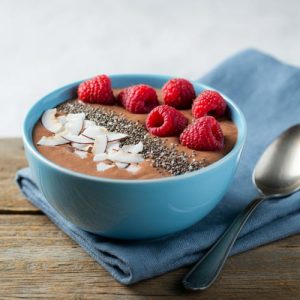
Your customers are increasingly seeking menu items that are not only delicious but also rich in nutritional benefits. A chocolate smoothie bowl might sound like a treat, but when you use high-quality cacao, it becomes so much more.
Let’s take a look at how to create a rich, decadent, and incredibly healthy cacao smoothie bowl that will have your customers coming back time and time again.
Why Cacao is a Menu Must-Have
Before we get to the recipe, let’s talk about the star ingredients: cacao powder and cacao nibs. It’s easy to confuse cacao with cocoa, but they are quite different. Cacao is the raw, unprocessed form of chocolate, and it’s loaded with health benefits that your customers will love.
- Rich in Antioxidants: Cacao is packed with flavonoids, which are powerful antioxidants that help protect the body from damage. In fact, raw cacao has one of the highest concentrations of antioxidants of any food.
- Source of Key Minerals: It’s a fantastic source of magnesium, which is essential for muscle function and energy production. It also provides iron, potassium, and zinc.
- Mood-Boosting Properties: Cacao contains compounds that can trigger the release of endorphins, leading to a feeling of well-being. A healthy treat that makes you feel good? That’s a winning combination.
By highlighting these benefits on your menu, you can appeal directly to customers who want food that works for their body, not against it.
The Perfect Cacao Smoothie Bowl Recipe
This recipe is designed for a commercial setting, focusing on consistency, flavour, and visual appeal. It yields one serving.
Ingredients
- 2 frozen bananas, chopped
- 2 tbsp raw cacao powder
- 1 tbsp almond butter (or other nut butter)
- 1/4 cup full-fat Greek yoghurt (or coconut yoghurt for a dairy-free option)
- 2-3 tbsp unsweetened almond milk (or milk of choice)
- 1 tsp maple syrup or honey (optional, for sweetness)
- A pinch of sea salt
Toppings
- 1 tbsp cacao nibs
- Fresh raspberries
- Sliced banana
- Chia seeds
- Shredded coconut
Instructions
- Prepare the Base: Combine the frozen bananas, cacao powder, almond butter, Greek yoghurt, and a small splash (start with 2 tbsp) of almond milk in a high-powered blender.
- Blend with Patience: This is the most crucial step for achieving that perfect thick texture. Start blending on a low speed, using the blender’s tamper to push the ingredients down towards the blades. Scrape the sides as needed. Avoid the temptation to add too much liquid, as this will result in a thin, drinkable smoothie rather than a thick, spoonable bowl.
- Adjust Consistency: If the mixture is too thick to blend, add the remaining tablespoon of almond milk. Blend until the mixture is completely smooth and creamy, with no lumps. It should have a consistency similar to soft-serve ice cream.
- Taste and Sweeten: Give the smoothie a quick taste. If your bananas weren’t overly ripe, you might want to add a small amount of maple syrup or honey for extra sweetness. Add a tiny pinch of sea salt to enhance the chocolate flavour.
- Serve Immediately: Pour the thick smoothie into a chilled bowl. This helps maintain its thick consistency.
- Garnish and Style: Now for the fun part. Artfully arrange your toppings. Sprinkle with cacao nibs for a satisfying crunch, add colourful fresh berries, a fan of sliced banana, and a dusting of chia seeds and shredded coconut. Presentation is key!
Tips for Cafe Success
Getting the smoothie bowl right every time comes down to a few simple tricks.
Achieving the Ideal Texture
The secret to a thick smoothie bowl is using minimal liquid and maximum frozen ingredients.
- Sliced Frozen Bananas: Peel and slice ripe bananas before freezing them on a tray. Once solid, pack them in handy packs of the equivalent of one or two bananas.
- Start with Less Liquid: You can always add more milk if needed, but you can’t take it away. Start with just enough to get the blender going.
- A Powerful Blender is Your Friend: A commercial-grade blender can handle frozen ingredients with less liquid, which is essential for achieving that creamy, thick texture.
Menu Appeal
How you describe your cacao smoothie bowl on the menu can make all the difference. Instead of just “Chocolate Smoothie Bowl,” try something more descriptive like “Rich Antioxidant Cacao Bowl” or “Decadent Cacao Power Bowl.” Be sure to list the key health benefits to attract discerning customers.
Add This Crowd-Pleaser to Your Menu
Offering a cacao smoothie bowl is a simple yet effective way to enhance your menu and cater to the growing demand for healthy, plant-based options. It’s visually appealing, incredibly nutritious, and tastes like an indulgent treat.
By mastering this recipe, you provide a delicious option that supports a healthy lifestyle. This can attract new customers and build loyalty among your existing ones who are looking for food that makes them feel great. Consider adding this stunning and wholesome bowl to your offerings and watch it become a new customer favourite.
Explore our range of superfood smoothie ingredients, available to bulk buy at wholesale prices.
This article was reproduced on this site with permission from operafoods.com.au the “Wholesale Café Suppliers”.
See original article:- Chocolate Smoothie Bowl for Health-Conscious Customers
Everything You Need To Know About Smoothie Powders
Calling all smoothie lovers. Maybe you looking to supercharge your smoothies with an extra dose of nutrition? Or perhaps you just want something a little easier and more convenient. Today, we’re exploring the ins and outs of smoothie powders. They can be a game-changer for your health regime and are incredibly easy to use.
What Does Smoothie Powder Do?
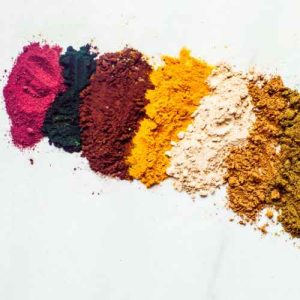
There are three main types of smoothie powder. There are those that replace the main ingredients of your smoothie. So, fruit powders, vegetable powders, or maybe protein powders. Then there are those that boost the nutrient content of your smoothie a little bit more. Things like maca powder, or ground flax. Finally, there are commercially prepared blends that include most (or all) of these in a single mix.
All of these are made from dehydrated ingredients that you simply reconstitute with a liquid. Usually water. The easiest and most convenient way is simply to stir or shake them, but you can also give them a quick whiz in a blender for totally smooth results.
Are Smoothie Powders Good For You?
But are smoothie powders good for you? Whilst we are all for what’s quick and easy, what about nutrition?
It turns out that they come with a pretty impressive set of creds on the nutrition front. Obviously, each one has a completely different profile from the next, but overall they can be a fantastic addition to your diet, especially if you struggle with getting enough fruits, veggies, or protein.
Yet, as with most things, the key is choosing the right ones and using them correctly.
Nutrients in smoothie powders
Vitamins and minerals
Fruit and vegetable powders are rich in essential vitamins and minerals that support overall health. You might find everything from Vitamin A for eye health to magnesium for muscle function. Whilst it is true that many vitamins, such as C, can degrade during processing and storage, the fact remains that most fruit and vegetable powders are rich and concentrated sources of most of the key nutrients found within the fresh produce itself.
Protein: essential amino acids
Protein powders, both vegan and dairy, offer a convenient way to increase your daily protein intake which is crucial for muscle repair and growth.
When you scoop into a jar of protein powder, what you’re getting is a concentrated dose of protein that’s been extracted and processed from its source—be it whey from milk, peas for the plant-based folks, or even crickets for the adventurous eaters among us (yes, that’s a thing!). But it’s not just about packing in the protein at the gym, these powders are for anyone needing a quick protein pick-me-up.
Fibre: insoluble and soluble
Whilst most smoothie powders boast that they contain plenty of fibre, which is great, it has already been broken down for you which means your body won’t have to do the work. In terms of soluble fibre this is not a problem, but when it comes to the indigestible fibre found in whole plants, the body does benefit from doing the work itself. Whilst this is by no means a downside, just be sure to include fresh wholefoods in your diet as well.
Fatty acids: Omega-3s and more
These powerful nutrients, known for their anti-inflammatory properties, are essential for heart health, brain function, and overall well-being. Some powders include flaxseed, chia seeds, or hemp, which are all excellent plant-based sources of Omega-3s. Getting enough Omega-3s in your diet can be tricky, especially if you’re not a fan of fish or are following a plant-based lifestyle.
Our top tip: While smoothie powders can amp up your nutrient intake, remember to check the labels for added sugars or artificial ingredients – your body will thank you for it! And don’t forget to include whole natural foods in your diet too.
What is the healthiest powder to add to a smoothie?
The healthiest powder to put in a smoothie depends on your own individual nutritional needs. Discovering a range of powders that, when put together, provide the balance of nutrients you need is far more effective than isolating one single powder or superfood.
That said, there are some single superfood powders that come with an impressive nutritional profile. Here are just a few.
Maca powder
Maca is largely revered as an adaptogen, a natural substance believed to help the body adapt to stress and promote balance and overall well-being. It is also well known for its potential in maintaining hormonal balance, making it a popular choice for those looking to align their endocrine system naturally.
Find out more in our article ‘maca; the superfood you need in your diet’
Goji berry powder
Goji berries contain ten times more antioxidants than blueberries, and are one of few fruits rich in fatty acids. Know in Chinese Traditional Medicine as the longevity fruit, goji berries are rich in plant chemicals that support eye health, improve memory, and aid restful sleep.
Cacao powder
Cacao is also rich in powerful antioxidants, as well as containing a staggering range of nutrients.
Not only is it loaded with antioxidants that fight off free radicals, but it’s also brimming with minerals like magnesium, which is great for your heart and brain. Plus, it has more calcium per gram than cow’s milk, making it a delicious option for bone health. And let’s not forget the mood-enhancing effects of cacao—thanks to the natural compounds that release feel-good hormones, adding a scoop of this decadent powder to your blend can actually make you feel happier. We call that a winner.
The Benefits of Smoothie Powders
The benefits of smoothie powders go beyond the simply nutritional.
Convenience
Just scoop, blend, and go! Smoothie powders simplify the process of getting your daily dose of vitamins and minerals, especially on those busy mornings.
Versatility
Whether you’re craving something sweet, looking to boost your protein intake, or wanting a refreshing drink, there’s a smoothie powder out there to help you crush those goals.
Longevity
These powders have a longer shelf life than fresh produce and don’t require any refrigeration, which means less waste and more bang for your buck.
Customization
Mix and match to create personalized blends that cater to your taste preferences and nutritional needs.
Portability
They’re perfect for people on the move. Pack some powder, find water, and you’ve got a nutrient-rich snack wherever you are.
Nutrient dense
And of course, as we have already seen, they’re concentrated sources of nutrients. With a single scoop, you’re often getting the equivalent nutritional benefits of multiple servings of fruits or vegetables.
To wrap it up, smoothie powders are simply about blending convenience with health. Quite literally.
We’ve got loads of super smoothie ingredients available to buy online, including all these smoothie powders that we have been talking about.
This article was reproduced on this site with permission from operafoods.com.au the “Smoothie Ingredients Distributors & Wholesalers”.
See original article:- Everything You Need To Know About Smoothie Powders
Boost your Brekkie: 8 Awesome Smoothie Bowl Toppings
What is a Smoothie Bowl?
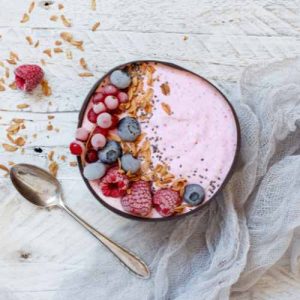
Similar to an acai bowl, a smoothie bowl is a thicker, spoonable version of a regular smoothie. It is usually made with frozen fruits and vegetables, along with some liquid such as milk or juice. Served in a bowl, this thick, ice-cold base is the starting point for any number of toppings that not only boost the nutrient content but add contrasting tastes and textures.
Not only are they visually appealing and Insta-worthy, but smoothie bowls also offer a convenient way to maximise your nutritional intake at the start of the day. Or any time of day really.
So now that is out of the way, the next obvious question involves toppings for your smoothie bowls.
Our Favourite Toppings for Smoothie Bowls
Toppings add taste and texture to your smoothie bowl, as well as that all-important nutrient boost. You can pretty much put anything on there but here are a few of our favourites that are as nutritious as they are delicious.
Topping 1: Fruit Powder
Fruit powder is a game changer when it comes to smoothie bowl toppings. Made by simply dehydrating fruits and grinding them into a fine powder, it packs all the flavour of fresh fruit, but in a storage-friendly form. From tangy berries to tropical mango, fruit powder not only adds a vibrant color to your smoothie bowl, but also a concentrated punch of vitamins, antioxidants, and natural sweetness.
Try our range our fruit powders
Topping 2: Chia Seeds
Chia seeds are tiny nutrition bombs that make a great topping for your smoothie bowl. Despite their small size, they’re packed with dietary fibre, protein, and a load of essential minerals. Not only do they add a satisfying crunch to your bowl, but when soaked in liquid (like milk or yogurt), they form a gel-like consistency for an extra creamy texture. Try using both for an interesting contrast.
Our black chia seeds are organic
Topping 3: Black Sesame
Black sesame seeds are the grown-up sophisticated cousin of your standard white sesame seeds. They have a slightly different flavour profile, with a nutty and slightly bitter taste. They also contain a higher level of antioxidants and essential fatty acids. Plus, the colour is great and can be used to striking effect. Think two-tone, rather than a riot of colour.
These black sesame seeds will boost your bowl
Topping 4: Cacao Nibs
Cacao nibs are the perfect topping for those who want to indulge their chocolate cravings more healthily. Essentially they are pieces of cacao beans that have been roasted, separated from their husks, and broken into smaller bits. They taste like dark chocolate but with a raw, more intense flavour and a satisfyingly crunchy texture. Cacao nibs are loaded with fibre, protein, and beneficial compounds like flavonoids.
Try these organic cacao nibs for an antioxidant boost
Topping 5: Dried Fruit
Dried fruit offers yet another textural contrast, bringing an almost candy-like chew. With all the sharp sweetness of fruit, in a concentrated flavour, they are also a longer-lasting store-cupboard-friendly option. As much as we love raisins, we are thinking along the more interesting lines of sharp sour cherries or tangy blueberries.
Try these organic dried cherries
Topping 6: Hemp Seeds
Hemp seeds aren’t about to win the pretty prize, but what they lack in insta-friendly colour they make up for in nutritional heft. They are a powerhouse of proteins and healthy fats, including omega-3 and omega-6 fatty acids, and they also serve as a rich source of dietary fibre and essential vitamins and minerals.
Our organic hemp seeds are hulled for better nutrient release
Topping 7: Pumpkin Seeds
Pumpkin seeds, also known as pepitas, bring a delightful crunch to your smoothie bowl. These tiny seeds are packed with protein, fibre, and a variety of essential minerals such as magnesium, iron, and zinc. They have a subtly sweet and nutty flavour, which pairs well with virtually any combination of smoothie bowl ingredients. Beyond their taste and nutritional benefits, their vibrant green colour will brighten your bowl, for an aesthetically pleasing and incredibly healthy topping.
Try these special variety Styrian hull-less pumpkin seeds for an easier eat
Topping 8: Bee Pollen
Bee pollen is a fantastic addition to your arsenal of smoothie bowl toppings. This natural byproduct of the beekeeping process is nutrient-rich, and filled with proteins, vitamins, minerals, and antioxidants. It has a mildly sweet yet floral taste that compliments a variety of fruits and other toppings. Prized for its potential health benefits, bee pollen may help to boost immunity and reduce inflammation. But remember, a little goes a long way; just a sprinkle of these golden granules is enough to give your smoothie bowl a nutritional and flavorful boost.
Our great-tasting raw Australian bee pollen
Basic Healthy Smoothie Bowl Recipe
More of a template than an exact recipe, this will help you get to grips with the basics and also act as a blueprint for endless creations of your own.
- Choose Your Base: Start by selecting your base ingredients. This could be a selection of your favourite fruits, like bananas, frozen berries, or mangoes. You will need some kind of liquid to help it along, but not as much as a traditional smoothie.
- Blend: Add your base ingredients to a blender. Blend until you achieve a smooth, even consistency. The mixture should be thicker than a traditional smoothie, allowing it to hold up your toppings.
- Pour and Spread: Pour your smoothie mixture into a bowl and spread it out evenly.
- Garnish with Toppings: Now comes the fun part. Use an assortment of seeds, nuts, fruits, granola or even bee pollen. Try to include a range of colours and textures to make your bowl aesthetically pleasing.
- Serve Immediately: Smoothie bowls need to be enjoyed right away. Grab a spoon and dive in!
Smoothie Bowl Ideas
Tropical Bliss Mango Smoothie Bowl
Blitz a base of ripe banana, frozen pineapple, and mango powder and top with shredded coconut and chia seeds.
Black Sesame Smoothie Bowl
Start with a base of frozen bananas and a spoonful of black sesame seeds, blended to a creamy consistency. A dash of almond milk will make your base smoother and infuse a subtle nutty flavour. For the toppings, add a sprinkle of black and white sesame seeds and a drizzle of honey. Super simple and let that star ingredient shine.
Chocolate Lover’s Smoothie Bowl
Begin with a base of ripe banana and a heaping spoonful of nut butter. Add a dash of milk and 2 tablespoons of raw cacao powder and blend. Top with crunchy cacao nibs and a handful of fresh raspberries.
Berry Chia Smoothie Bowl
Make a base of blueberries and frozen banana with a splash of any milk. Top with a handful of granola, some more blueberries, and a generous sprinkle of chia seeds.
Cherry-Nut Smoothie Bowl
For the base, blend frozen banana, a handful of dried cherries, and a splash of milk. Top with a sprinkle of chopped almonds, a few more dried cherries, and a dollop of Greek yoghurt.
Detox Green Smoothie Bowl
For the base, blend a ripe banana, a chopped kiwi fruit, a handful of spinach leaves, a few kale leaves, and a splash of almond milk. Top with a generous amount of hemp seeds, and a few more slices of kiwi.
Autumn Pumpkin Smoothie Bowl
Start with a base of frozen bananas and a small pumpkin, peeled and cubed. Add a dash of almond milk for a smoother texture and blend until creamy. Stir in a spoonful of honey for a hint of natural sweetness. Sprinkle raw pumpkin seeds, a dollop of Greek yogurt, and a dash of cinnamon.
Bee Pollen Breakfast Smoothie Bowl
Make a base of frozen banana, oats and oat milk. Drizzle with honey, top with Greek yoghurt, and a good scatter of bee pollen.
We have seen that from chocolate lovers to detox enthusiasts, there’s a bowl for everyone. Experiment with ideas for bases and toppings, mix and match ingredients as per your liking, and you’ll discover that breakfast can indeed be the most exciting meal of the day. Remember, the key to great breakfast smoothie bowls is using high-quality, fresh ingredients and finishing them with your favourite toppings.
Our top tip for the perfect smoothie bowl? Allow your frozen fruit like banana or pineapple to defrost slightly before blending. This will make it easier to blitz, and save your blender motor!
Explore our full range of superfood ingredients for your smoothie bowl.
This article was reproduced on this site with permission from operafoods.com.au the “Smoothie Bowl Topping Wholesalers”.
See original article:- Boost your Brekkie 8 Awesome Smoothie Bowl Toppings
Make the Perfect Healthy Smoothie: What to Include and Why

Smoothies are more than just a popular trend; they’re a fantastic way to pack a wealth of nutrition into a delicious, convenient meal. Perfect for on-the-go breakfasts or nutrient-packed snacks, a healthy smoothie can be tailored to suit any taste or dietary requirement.
Whether you’re a smoothie pro looking for new ideas, or you’re just beginning your journey into the world of blended meals, this guide is here to help. We’ll explore the key ingredients for a healthy smoothie, take a look at some of the benefits they offer, and share some ideas for smoothie combinations.
Blenders at the ready, it’s time to start making the perfect healthy smoothie!
The Key Ingredients for a Healthy Smoothie
Before we look at some specific ingredients, let’s quickly consider the anatomy of a smoothie because there is one very important component that is easy to overlook. That’s right; liquid. Without liquid, your smoothie is going nowhere.
What liquid is best for making a smoothie?
A smoothie doesn’t really need a lot of liquid. The liquid has two parts to play. It helps give the desired consistency, but it also helps keep things moving in the blender. If you have ever tried to blend something like frozen banana chunks in a personal blender just to have the blades spin and the motor burn, then you know exactly what we are talking about.
The best liquid for making a smoothie largely depends on your personal preference and nutritional goals. the main question is whether you do dairy or you don’t.
Water is a simple addition that can keep the flavours clean without the addition of extra calories (or nutrients).
Milk (including non-dairy versions like almond, soy, or oat milk) adds a creamy texture and can contribute additional protein and nutrients.
Coconut water is a refreshing choice that can help to hydrate and replenish electrolytes after a workout.
Fruit juice can add sweetness, acidity and an extra dimension of flavour as well as vitamins and minerals.
Remember, the key is to choose a liquid base that complements your other ingredients and aligns with your health objectives. Just be mindful of added sugars in some milk alternatives and fruit juices. Now we have the liquid part covered, let’s look at the other key ingredients in a healthy smoothie.
What are the best ingredients to put in a smoothie?
Fruits and berries
These are fundamentally the heart and soul of any good smoothie. They provide natural sweetness, vibrant colours, and a variety of textures. More importantly, they are packed with essential vitamins, minerals, and antioxidants that promote a healthy body and mind. Whether fresh frozen, or powdered the possibilities are endless, allowing you to mix and match to create your perfect blend.
Vegetables
They may not be quite as appealing as fruit but they are loaded with fibre, which aids digestion, and are rich in vitamins and minerals. They also offer particular plant nutrients that you won’t find in fruit, and of course, contain less sugar. Leafy greens like spinach or kale are a popular choice, but don’t shy away from adding other veggies like cucumber, carrot, or even beets for a refreshing twist.
Proteins
Crucial for a balanced smoothie, proteins provide substantial satiety and aid muscle recovery, particularly after exercise. There are many ingredients you can add to a smoothie to boost the protein content. Here are just a few.
- Protein Powder: If you’re really looking to ramp up your protein intake, consider adding a scoop or two of protein powder. There are many options out there, including plant-based varieties like pea or hemp protein.
- Greek Yogurt: Greek yogurt not only provides a hefty dose of protein but also contributes a creamy texture to your smoothie.
- Nut Butter: Whether it’s peanut, almond, or cashew, nut butter can add a delicious, protein-filled punch to your smoothie.
- Chia Seeds: These little seeds are not only a good source of protein but also packed with essential omega-3 fatty acids.
Healthy Fats
These are another vital component of a balanced smoothie. Here are some great ingredients you can add to your smoothie for a healthy fat boost. Many of them also include protein so you get two for the price of one, so to speak. Nuts and seeds are excellent examples of ingredients that provide a cross-spectrum of valuable nutrients. You may find our article on super seeds useful.
- Avocado: This creamy fruit is high in monounsaturated fats, which can help to reduce bad cholesterol levels and lower the risk of heart disease.
- Flaxseeds: As well as protein, flaxseeds are packed with omega-3 fatty acids.
- Chia seeds: Chia seeds are also a great source of omega-3 fatty acids.
- Hemp seeds: These little seeds are rich in both omega-3 and omega-6 fatty acids, and they’re also a great plant-based protein source.
- Coconut oil: It’s high in medium-chain triglycerides (MCTs), a type of fat that your body can absorb and use quickly.
- Almond butter: Almonds are rich in monounsaturated fats, and also provide a good dose of vitamin E. Choose an almond butter with no added sugars or oils for the healthiest option.
- Walnuts: Walnuts are a great source of omega-3 fatty acids, which help to reduce inflammation. They’re also rich in antioxidants.
Powdered Superfoods for a Superfood Smoothie
Most of the ingredients we have already talked about can be considered superfoods in their own right. Yet as powdered superfoods become more and more available, they deserve a special mention. Not only can they provide a super nutritional boost to your smoothies, but they are easy to blend and have the added benefit of a longer shelf life than fresh produce. You can find out more in our guide to superfood powders.
Fruit powders
These can be used instead of or alongside fresh fruit. Use them to target specific nutrients, or to create interesting flavour combinations. Plus, they are super easy to use.
Explore our range of fruit powders
Greens powders
These are a really good way to add the nutritional benefits of vegetables, without altering the flavour profile of your smoothie too much. And not just greens, consider adding beetroot or carrot powders too.
Explore our range of vegetable powders
Protein powders
These got a mention before, but they are an excellent way to boost the protein power of your smoothie.
Explore our range of protein powders
Superfood powders
These include all of the above yet there are some other ingredients that can give you an extra boost, such as cacao or maca powder.
Here’s some other smoothie ingredients you may like
And finally, here’s a bunch of ideas (see what we did there) for healthy smoothies.
Some of our Favourite Healthy Breakfast Smoothies
When it comes to healthy breakfast smoothies you want something that will fill you up and keep you going throughout the morning, and possibly even well into the afternoon. Oats are great, as is an extra protein boost as well as some healthy fats.
Banana Coffee Kick-starter: A smoothie perfect for those who want an early morning energy boost. Blend bananas with a shot of espresso, a splash of almond milk, and a scoop of vanilla protein powder.
Blueberry Muffin Smoothie: Capturing the flavours of a blueberry muffin, this smoothie includes blueberries, oats, almond milk, and a dash of vanilla extract. Sweeten with a little honey if desired.
Carrot Cake Smoothie: Create this dessert-like smoothie with fresh carrots, banana, almond milk, a touch of cinnamon, and a spoonful of vanilla protein powder. Top with walnuts for a crunchy finish.
Peanut Butter Oatmeal Smoothie: For a hearty breakfast, blend oats, peanut butter, banana, and your choice of milk. This smoothie will keep you full and energized all morning.
Banana Oatmeal Smoothie: Ideal for a filling breakfast, this smoothie includes bananas, oats, and almond milk. A drizzle of honey will add a hint of sweetness.
Green Tea Smoothie: This smoothie combines the health benefits of green tea and spinach. Blend these with bananas and honey for a deliciously sweet and healthy drink.
More Banana Smoothie Ideas
Banana is the ideal base for any smoothie, with its sweet taste and creamy texture. There’s no wonder it is the most popular smoothie ingredient out there.
Tropical Banana Smoothie: Transport yourself to the tropics with this blend of banana, pineapple, and coconut milk. Add a squeeze of lime for a tangy twist.
Cinnamon Banana Smoothie: This smoothie is like a drinkable banana bread. Blend bananas with a touch of cinnamon, a dash of vanilla extract, and almond milk.
Banana Chocolate Smoothie: A healthy yet indulgent option, blend bananas with cacao powder and almond milk. Add a scoop of chocolate protein powder for extra protein.
More Green Smoothie Ideas
There’s no need to be scared of a green smoothie. When combined with clever ingredients, you won’t encounter the dreaded green sludge.
Green Goddess Smoothie: This smoothie is packed with nutrients from avocado, spinach, green apple, and almond milk. Sprinkle with chia seeds for a boost of fibre.
Zesty Green Smoothie: Blend lime, spinach, cucumber, and coconut water for a refreshing and zesty green smoothie that’s perfect for summer.
Minty Fresh Green Smoothie: Blend spinach, mint leaves, green apple, and almond milk for a refreshingly minty green smoothie. Add a dollop of yogurt for added creaminess.
More Peanut Butter Smoothie Ideas
Everybody loves peanut butter but don’t forget you can switch out any nut butter you like.
PB&J Smoothie: For a twist on a classic, blend together strawberries (or any of your favourite berries), peanut butter, and milk.
Chocolate Peanut Butter Smoothie: For a dessert-like option, blend natural peanut butter, banana, cacao powder, and your choice of milk.
Peanut Butter Berry Smoothie: Blend your favourite mixed berries, natural peanut butter, and almond milk for a fruity and nutty delight.
There you have it, an array of smoothie ideas that are as delicious as they are nutritious. Whether you’re a fan of fruity flavours, a green machine, or a peanut butter lover, there’s sure to be a smoothie for you. A healthy breakfast smoothie will set you up for the day, but smoothies are a usual addition to your nutritional arsenal any time of day.
Don’t forget to explore our full range of smoothie ingredients, available to order online right now. There’s even a bulk buy option for some great savings.
This article was reproduced on this site with permission from operafoods.com.au the “Smoothie Nutrients & Ingredients Suppliers”.
See original article:- Make the Perfect Healthy Smoothie: What to Include and Why
Boosting your diet with super greens powders
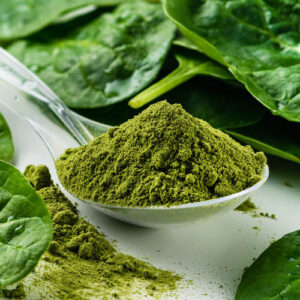
There are many reasons you may want to boost your diet with super greens powders. But why are green vegetables just so good for you?
Are green powders healthy?
Green powders are an excellent way to boost your nutrient intake with the power of green vegetables. Designed as a nutritional supplement rather than an alternative, green powders are great for when you need extra nutrients in your diet or, for whatever reason, are finding it difficult to make your fruit and veg targets.
Why are green vegetables good for you?
Green vegetables are full of a pigment called chlorophyll. They also contain a whole host of other nutrients for very little calories which makes them some of the most nutrient dense foods around. Find out why green vegetables are some of the most super superfoods around.
What is chlorophyll?
Chlorophyll is a green pigment found in plants that helps them to convert sunlight into energy. For humans it acts as a powerful anti-oxidant. Generally, but not necessarily, the more green the vegetable the more chlorophyll it contains. That said, if you choose dark green vegetables to include in your diet, you can be sure of a good source of chlorophyll as well as plenty of other nutrients.
What are dark green vegetables?
All vegetables (and fruits) have some nutritional benefit, and the best health advice you can follow is to eat the rainbow. Quite simply this means to eat a wide range of fresh produce, choosing as many different varieties and colours as you can. Fruits and vegetables all contain pigments that give them their colour. These pigments are known as phytonutrients (or plant chemicals) and they are what makes this food category so unique, and so beneficial. The more colours you eat, the higher your intake of beneficial plant chemicals.
Dark green vegetables are a group of vegetables that share similar nutritional characteristics. Other vegetables that are green but do not share the same nutrient profile belong in a different group. Celery, for example. Or iceberg lettuce. These both contain vital nutrients, just different ones. Dark green vegetables may share similarities yet they each have something unique to offer. So within that rainbow, choose many varieties of each colour as well as individual colour groups.
Green leafy vegetables
Most dark green vegetables also come under the heading of leafy greens. There are salad greens, such as rocket and watercress. Then there are those such as kale and chard, which are generally cooked. Broccoli is related to kale, yet also to cauliflower. Some varieties of broccoli are more leafy than others. Baby spinach is seen primarily as a salad leaf, whilst mature spinach tends to need cooking.
Kale and spinach are both examples of leafy greens, and are pretty much nutritional royalty.
Is spinach good for you?
Yes, spinach is super good for you. Not only a good source of chlorophyll, it is packed with vitamins and minerals including over a dozen antioxidant flavonoid compounds to protect against heart disease and bolster your immune system. Spinach is an excellent source of vitamin K that is essential for blood clotting and maintaining healthy bones.
Is kale good for you?
Kale is also exceptionally good for you. Beyond giving that chlorophyll boost, kale is full of amazing nutrient properties. Did you know it contains a substance that can help to balance oestrogen? It also helps to protect bones with calcium and magnesium alongside vitamin K. Kale is also rich in beta-carotene and vitamin C.
How much protein in kale and spinach?
Whilst not protein powerhouses, kale and spinach do not do too badly in the protein stakes. We explore protein supplements in this post about protein powder.
How to use greens powder
Our spinach powder is an excellent way to boost your nutrient intake and ensure you are not missing out on healthy ingredients. This kale powder will also make sure you are getting the nutrients you need.
Simply stir into water, juice, milk or smoothies. You can also add to soups and stews, or even dips and salad dressings. They work particularly well with egg dishes such as scrambled egg or omelette.
How to make green powder taste better
It is true that greens powder can be fairly unpalatable. Luckily we wrote an entire post about green smoothies and how to make them taste nice.
Buy your greens powder online today, and take advantage of our bulk buy savings.
Think you are getting enough greens? Why not check out some of our veggie smoothie recipes.
This article was reproduced on this site only with permission from our parent co. operafoods.com.au the “Gourmet Online Wholesale Grocer”. See the original article here:- Boosting your Diet With Greens Powders
Ten different ways you can make a banana smoothie more interesting
Bananas are one of the most used ingredients in smoothies, milkshakes and smoothie bowls. Their soft texture is instantly creamy and they have a sweet flavour that goes with everything.
You can make a banana smoothie with fresh or frozen banana or you can use a dehydrated banana powder for instant store-cupboard convenience.
We take a look at why bananas deserve superfood status, and the many ways you can use them in your smoothies.
Are bananas good for you?
Because of their sugar content bananas became a bit of a dirty word with the anti-carbohydrate crowd. Yet bananas contain both quick release sugars and slow release sugars so provide a great overall energy boost. Higher in calories than other fruits, they also provide more fat, more fibre and more protein.
Bananas are an excellent source of potassium which is essential for controlling fluid balance and blood pressure. A natural prebiotic, they also contribute to gut health by feeding the good bacteria in your tummy. Bananas also contain antacids which are why they are so good for indigestion and soothing an upset stomach. A great beauty food, they contain antioxidant lutein that boosts skin elasticity and controls sebum levels. Ripe bananas have higher levels of antioxidants.
One medium banana provides, on average, 105kcal, 0.4g fat, 10g sugars, 3g fibre and 1.3g protein. It is rich in vitamin B6 and C, biotin, copper, manganese, potassium, fibre and lutein.
Basic banana smoothie recipe
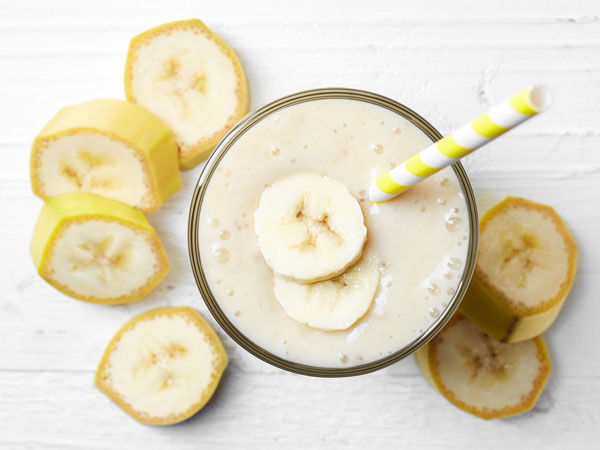
A basic banana smoothie is made from milk (dairy or otherwise) and bananas. Fresh banana will thicken and sweeten, whilst frozen banana will thicken, cool and sweeten. The frozen banana will have a less pronounced sweetness and banana flavour because the cold dulls the senses a little. Banana powder will not thicken, but it will flavour and sweeten. It also contains all the nutritional value of a fresh banana.
For a basic banana smoothie
1 cup milk
1 banana, frozen or fresh
or
1 tbsp banana powder
Banana powder, and other powders, are useful if you don’t have a blender. Just put the ingredients in a shaker and shake to blend. Or put them in a bowl and whisk together. Other ingredients such as peanut butter, vanilla extract, or seeds and grains such as oats or chia, can also be added without a blender.
Make your banana smoothie more interesting by adding…
Mango
Add fresh, frozen or powdered mango to your smoothie. Not only will it add extra tropical flavour, but is also full of antioxidant beta-carotene and vitamin C. Mango is also full of fibre and a good-for-your-gut prebiotic.
Nut butter
Adding a nut butter such as peanut butter to your banana smoothie will add a lovely creamy nutty texture and salty flavour. Nuts are high in essential fatty acids and are super good for your skin.
Berries
Berries bring additional fruity flavour and you can add them in fresh, frozen or powdered form. Full of antioxidant plant power, berries are immune boosting, inflammatory fighting superfoods.
Oats
A few tablespoons of oats added to your smoothies will help to thicken and add extra creamy texture. Oats will slow down the release of blood sugars and lower LDL cholesterol levels. They also add as a natural sedative. Oats are the original comfort food.
Protein powder
Protein powder will help to thicken your smoothies and help keep you feeling fuller for longer. Choose dairy or non-dairy but the nutrient values will differ.
Maca
Maca powder has a unique malty flavour that goes particularly well with bananas and milk. It is a powerful adaptogen that helps to balance stress and hormones as well as enhancing energy.
Chia seeds
Chia seeds will help to thicken your smoothie and boost the levels of essential fatty acids and protein. Leave it to stand once mixed in order for the chia seeds to swell.
Cacao
Cacao, the raw form of chocolate, goes well with banana and turns your banana smoothie or shake into chocolate heaven. Don’t be put off by the fact that it is raw as the flavour is actually less bitter than cocoa powder. Or you could add cacao nibs for crunchy texture. Either way you get a healthy dose of powerful antioxidants.
Honey
You can add extra sweetness with a spoonful of honey, or add an interesting crunch with bee pollen. Both have a range of natural nutrients than can only enhance the quality of your smoothie.
Vanilla
Vanilla adds a comforting sweetness to anything, especially banana. Use good quality extract. Freshly grated nutmeg also gives a comforting sweetness to the milk/banana combo.
You could choose just one of these elements to make your banana smoothie more interesting, or combine a few. The variations become endless.
You will find these smoothie ingredients and more here at Boost Nutrients, or head over to the online store to buy bulk food online.
How to get an easy nutrient boost with some simple veggie smoothie recipes

Hard root veg such as beetroot and carrots can be notoriously difficult to blend into smoothies and generally require roasting first if you want them to blend in smoothly. Yet a veggie smoothie is the ideal way to harness the power of vegetables and benefit from all of those unique nutrients.
So what’s the answer? We think that vegetable powders are the ideal solution and that making easy veggie smoothies is the best way to make use of these handy pantry ingredients.
What is the benefit of a veggie smoothie?
If it is a difficult thing to make, why bother with a veggie smoothie at all? Why not stick to fruit? It tastes nicer anyway.
Because of their lower sugar content, vegetables are considered to be more nutrient dense than fruit. And the same principles as drinking smoothies in general applies – you can fit more goodness in a glass than on a plate. And let’s face it, how many of us are preparing vegetables like beetroot on a daily basis?
Beetroot and carrots are packed with beneficial nutrients, but they can be hard to break down in a smoothie without roasting first. Yet they deliver so many vital nutrients it would be a shame to miss out.
Rich in beta-carotene, the precursor to Vitamin A, carrots promote eye health. High in fibre, they also fill us up and help stave off hunger for longer. Carrots also contain silicon, for beautiful skin and nails.
Beetroots contain a unique group of antioxidants called betacyanins, that support the liver, improve circulation and purify the blood. An anti-diabetic compound known as choline can help regulate blood sugar levels. Beetroot juice is also known to lower blood pressure soon after drinking it.
Make use of dehydrated vegetable powders to add the power of fresh raw vegetables to your smoothies. As these powders are so concentrated, we recommend that you use the powders as a boost to other ingredients to give plenty of texture. Try the recipes below as a starting point.
Recipe for a simple carrot based veggie smoothie

For 1 x 8oz serving
1 cup orange juice

1 cup frozen mango chunks

1 tablespoon goji berries

2 teaspoons carrot powder

1 tablespoon hemp protein powder
- Blitz in a blender until smooth.
Recipe for a simple beetroot based veggie smoothie
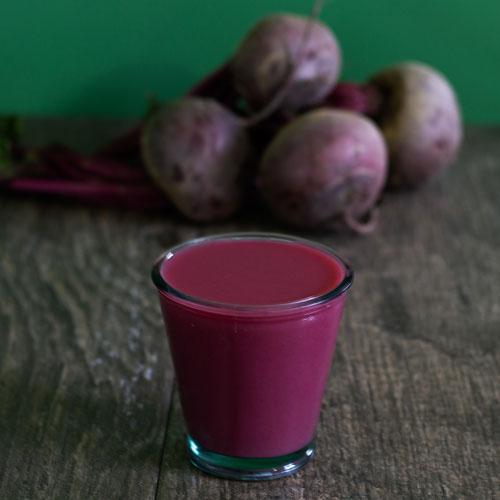
For 1 x 8oz serving
1 cup pomegranate juice

1 cup frozen berries

1 tablespoon acai powder

2 teaspoons beetroot powder

1 tablespoon LSA mix
- Blitz in a blender until smooth.
You can view all of these smoothie ingredients and more, or why not take advantage of bulk buy wholesale prices at our online store?
Make a healthy smoothie for kids with these three great recipes

Making a healthy smoothie for kids is more about increasing their fruit and vegetable intake than boosting with superfood nutrients. When we make smoothie recipes for adults, yes it is about getting in lots of the good stuff, but we also try to make every calorie count with nutrient boosts such as maca or goji.
Here we take some simple ingredients, and maybe a few hidden veg, to make some delicious child-friendly smoothies. Perfect for morning or afternoon snack time to keep energy levels up and little brains ticking.
Secret greens smoothie recipe
Sharp kiwi and mild sweet pear act as the perfect foil for the green goodness of spinach. You could use milk as the base to create a milder creamier smoothie, or just stick to water. You could use apple juice but that will up the sugar content for little teeth. Feel free to use fresh, frozen or canned pear; frozen will give a thicker, more frosted texture. You can add more or less liquid according to your child’s preference. Instead of fresh spinach, you could substitute with a half teaspoon of our spinach powder. Straight from the pantry, it is an easy way to sneak in those hidden veggies.
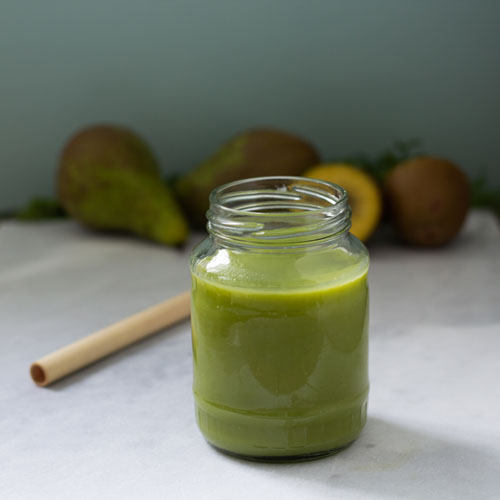
Makes 2 x 4oz servings
1 cup water or milk
1 cup pear chunks, fresh or frozen
1/2 cup baby spinach leaf
1/4 cup chopped kiwi fruit
- Add to a blender and blitz until smooth
Tropical treat healthy smoothie for kids
Kids seem to love mango. Maybe its the sweet fruity flavour or maybe its that thick slippery texture. Whatever the story, it is all good news as mango is packed with vitamin C and other healthy goodies. You can hide a bit of carrot in here for extra veg; use juice or substitute with half a teaspoon of carrot powder. Again, feel free to use fresh, frozen or tinned fruit and adjust the consistency to your child’s taste.
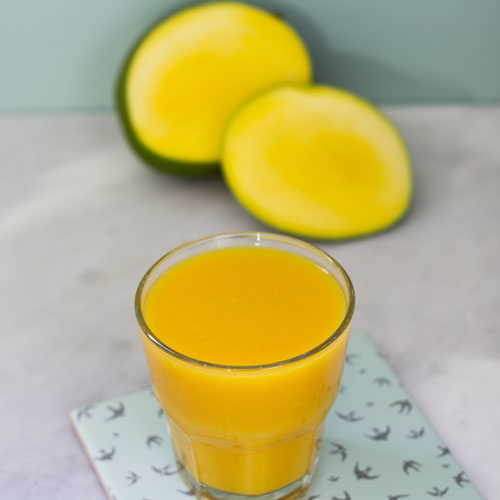
Makes 2 x 4oz servings
1 cup coconut milk
1 cup mango chunks, fresh or frozen
1/2 cup pineapple chunks, fresh or frozen
1/4 cup carrot juice
- Add to a blender and blitz until smooth
Peach melba shake smoothie recipe
By using more milk to fruit, and even a spoonful of whey protein powder, you create more of a shake than a smoothie. Using frozen fruit will give a thick shake effect, like a burger shake made with ice cream. For a quick storecupboard fix you could use our fruit powder; substitute about a teaspoon of either the berries or the peach. If you wanted to use both powders, add more banana for texture.
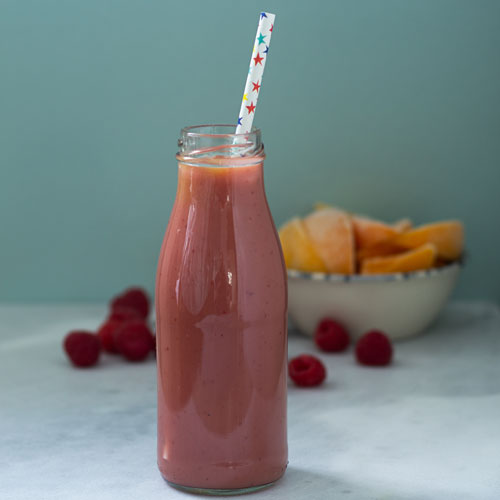
Makes 2 x 4oz servings
1 1/2 cup of milk
2 teaspoons whey protein powder
1/2 cup frozen raspberries
1 cup frozen peaches
1/2 banana
- Add to a blender and blitz until smooth
To sum up, it is easy to get more fruit (and even veg) into kids and set them up with good habits for life.
Check out our range of smoothie ingredients that are perfect for the pantry, or head over to our bulk store for organic wholesale prices.
Breakfast healthy smoothie recipe. Get the best possible start to your day!
This breakfast healthy smoothie recipe is ready in minutes and can even be made using only store cupboard ingredients.
A thick and satisfying smoothie makes the perfect breakfast, quick to make and easy to digest it gives you everything you need in one delicious go.
So why not start your day the right way with all the nutrients you need to be at your best.
Breakfast healthy smoothie recipe
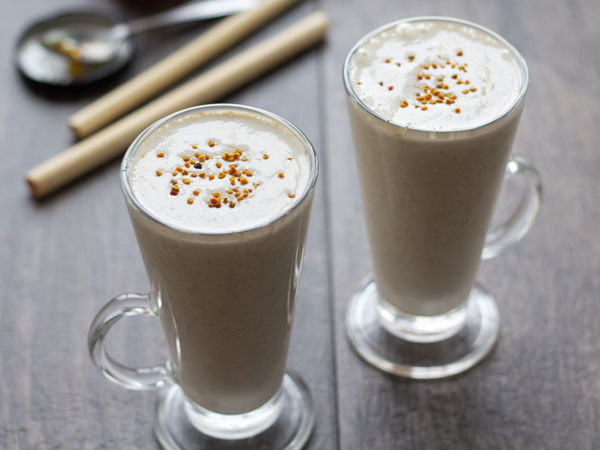
Easy to drink, and easy to digest, this breakfast smoothie will fill you up and keep you feeling fuller for longer. Made with milk as a base, it is up to you whether you go dairy or non-dairy. With added protein powder for a creamier texture and extra amino acids, again you can choose whether to go dairy or plant-based. Banana is the ideal fruit for breakfast, particularly in a smoothie where it blends into creamy sweetness. Not just about flavour though, banana packs a punch in the nutrient department with resistant starch for blood sugar control and plenty of heart-healthy potassium. Oats deliver that all important carbohydrate energy, but in the slow-release form of beta-glucan.
Throw in some maca powder for its magical powers and add in a dash of flax for fibre. By the way, did you know that both of these superfoods helps to balance hormones? Yeap. And that is just as relevant for men as it is for women.
To make this recipe you will need…
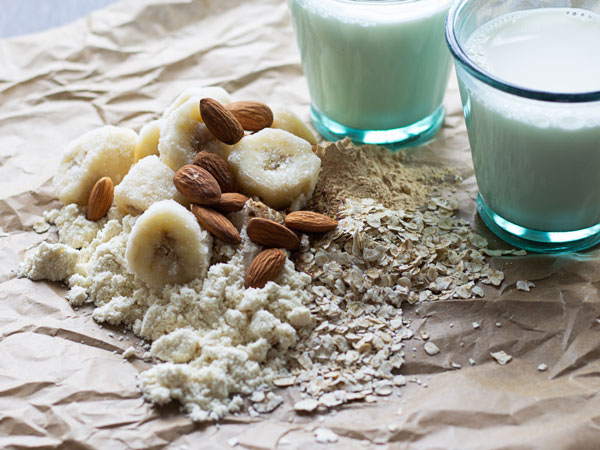
2 cups milk, dairy or non-dairy
1 banana, frozen in chunks or 1 tbsp banana powder
1/3 cup oats
3 tbsp whey concentrate or vegan protein powder
1 tbsp maca powder
1/4 cup raw almonds
1 tbsp flax powder or LSA mix
For the garnish
Drizzle of honey
1 tbsp bee pollen
And now for the method…
There’s only 3 steps.
- Blitz
- Pour
- Garnish with bee pollen and a drizzle of honey
Take a look at all of our ingredients for smoothies or you can even bulk buy online direct from us.